


Leather theater seating has long been the default choice for serious home cinema rooms. The look is unmistakable, the feel is comfortable from day one, and the association with quality runs deep enough that most buyers don't question it. The regret comes later — often 18 to 24 months after purchase — when the surface starts peeling, cracking, or feels nothing like the showroom sample that originally sold them on it.
The problem isn't always the choice between leather and something else. It's the choice between leather types. Real leather, top-grain leather, bonded leather, faux leather, and PU leather are not interchangeable terms — and the difference between them determines whether a home cinema seat lasts a decade or starts deteriorating within two years of regular use. This guide cuts through the confusion.
Real Leather vs. Faux Leather: The Core Differences at a Glance
Before comparing category by category, it helps to understand what each material actually is:
- Full-grain leather: The top layer of the hide, unaltered. Natural imperfections are visible. Most durable, most expensive, develops a patina with age.
- Top-grain leather: The top layer is lightly sanded for a uniform finish. Slightly less durable than full-grain but softer and more consistent in appearance.
- Bonded leather: Scraps and fiber are shredded and pressed together with adhesive onto a backing. Looks like leather, degrades like cardboard under stress. Peels predictably.
- Faux / PU leather: Polyurethane coating bonded to a synthetic fabric backing. No animal content. Quality varies significantly by grade.
Comparing Real and Faux Leather Across What Actually Matters
Comfort: Which Feels Better During Long Movies?
Real leather is breathable. Natural collagen fibers allow air exchange, which means the surface adapts to body temperature rather than trapping heat. In a room-temperature theater, a top-grain leather seat feels comfortable within seconds of sitting. In warmer climates or rooms without climate control, the breathability advantage becomes significant during two-hour sessions.
Faux leather doesn't breathe. PU and PVC coatings are plastic-based, which means they retain heat and can feel sticky during extended use. Quality performance-grade PU leather has narrowed this gap through improved backing fabrics and surface textures, but the fundamental breathability difference remains. For buyers in warmer regions or anyone planning long daily viewing sessions, this isn't a minor consideration — it's felt on every movie night.

Durability and Longevity: What Actually Lasts Longer
The lifespan gap between real and faux leather is wider than most buyers expect at the point of purchase. According to a survey of 4,212 sofa owners conducted by consumer watchdog Which?, faux leather was the most damage-prone choice of sofa fabric — with owners significantly more likely to report ripping, scratching, staining, and general wear and tear compared to other materials. Real leather in the same conditions consistently outperformed every faux alternative on longevity.
The failure mechanism of faux leather is structural, not just cosmetic. PU coatings undergo chemical breakdown and delamination over time — a process accelerated by body heat, body oils, and repeated flexion in exactly the high-contact areas a theater seat sees most: headrests, armrests, and seat edges.
Budget faux leather is notorious for peeling within 1–3 years. Commercial-grade PU with higher double-rub counts can extend that to 5+ years, but it still falls well short of genuine leather's lifespan at equivalent quality tiers.
Maintenance and Cleaning: What You'll Deal With Long-Term
This is where faux leather has a genuine, real-world advantage — at least early in the product's life. PU leather is resistant to spills and stains, requires no conditioning, and wipes clean with a damp cloth. For households with children or pets, that simplicity has real value.
Real leather requires periodic conditioning — typically every 6 to 12 months — to replenish natural oils and prevent the surface from drying out and cracking. Without it, even top-grain leather becomes brittle. It also stains more readily than faux leather if spills aren't addressed quickly.
The maintenance advantage of faux leather is real but time-limited. Once delamination begins, no care routine reverses it. Real leather, properly maintained, can be repaired, re-dyed, and reconditioned across decades.
Price vs. Value: Where You Should Actually Spend
Faux leather theater seating costs significantly less upfront. That price gap narrows considerably when replacement cycles are factored in. A $1,200 faux leather seat, replaced every five years, costs $240 per year of use. A $2,800 real leather seat lasting twenty years costs $140 per year — and often retains resale value, the faux leather version never will.
The math shifts in favor of real leather at any usage intensity above casual. The exception is buyers who prefer to refresh furniture every few years or face firm budget constraints. In those cases, mid-grade commercial PU leather is the right faux leather to consider — not bonded leather, which should be avoided at any price point.
Aesthetic Impact: Look, Feel, and Perceived Quality
Real leather is visually distinctive in ways that faux leather cannot fully replicate. The natural variation in grain, the slight sheen that develops with use, and the way it softens and conforms to the body over time all contribute to a quality signal that reads immediately in a well-designed theater room.
High-grade faux leather looks nearly identical in photographs and holds up aesthetically for the first few years. Over time, the uniformity that makes it initially appealing becomes a liability — synthetic surfaces don't develop character, they develop wear. Black leather theater seating is particularly revealing on this front: real leather ages into a richer, deeper surface, while black faux leather tends toward a dull, cracked finish under heavy use.
Performance in Different Home Environments
Real leather performs best in temperature-controlled rooms with consistent humidity. It's sensitive to prolonged sun exposure and dries out in very low-humidity environments without conditioning.
Faux leather is more forgiving in variable conditions. It handles moisture better than untreated real leather and doesn't require the environmental consistency that genuine leather benefits from. For basement theater rooms or spaces with less climate control, quality faux leather may actually be the more practical material choice.
How to Choose the Right Leather Theater Seating (Step-by-Step)
- Identify your usage intensity. Daily, multi-hour use favors real leather. Occasional use makes quality faux leather more defensible.
- Set a realistic budget using cost-per-year logic. Divide the seat price by the expected lifespan before comparing options.
- Confirm the leather grade. Ask specifically: full-grain, top-grain, bonded, or PU? Reject vague descriptors like "genuine leather" without grade specifics.
- Assess your room environment. Warm climates, basement rooms, or households with pets and children may tilt toward performance-grade faux leather.
- Check the warranty coverage. Reputable manufacturers cover upholstery separately from mechanisms; a 3–5 year upholstery warranty signals confidence in the material.
- Request a material sample. Color and texture on screen differ from reality; confirm both before placing an order.
Upholstery grades vary significantly across brands. Browsing the home theater seating collection helps compare specifications across models before committing.
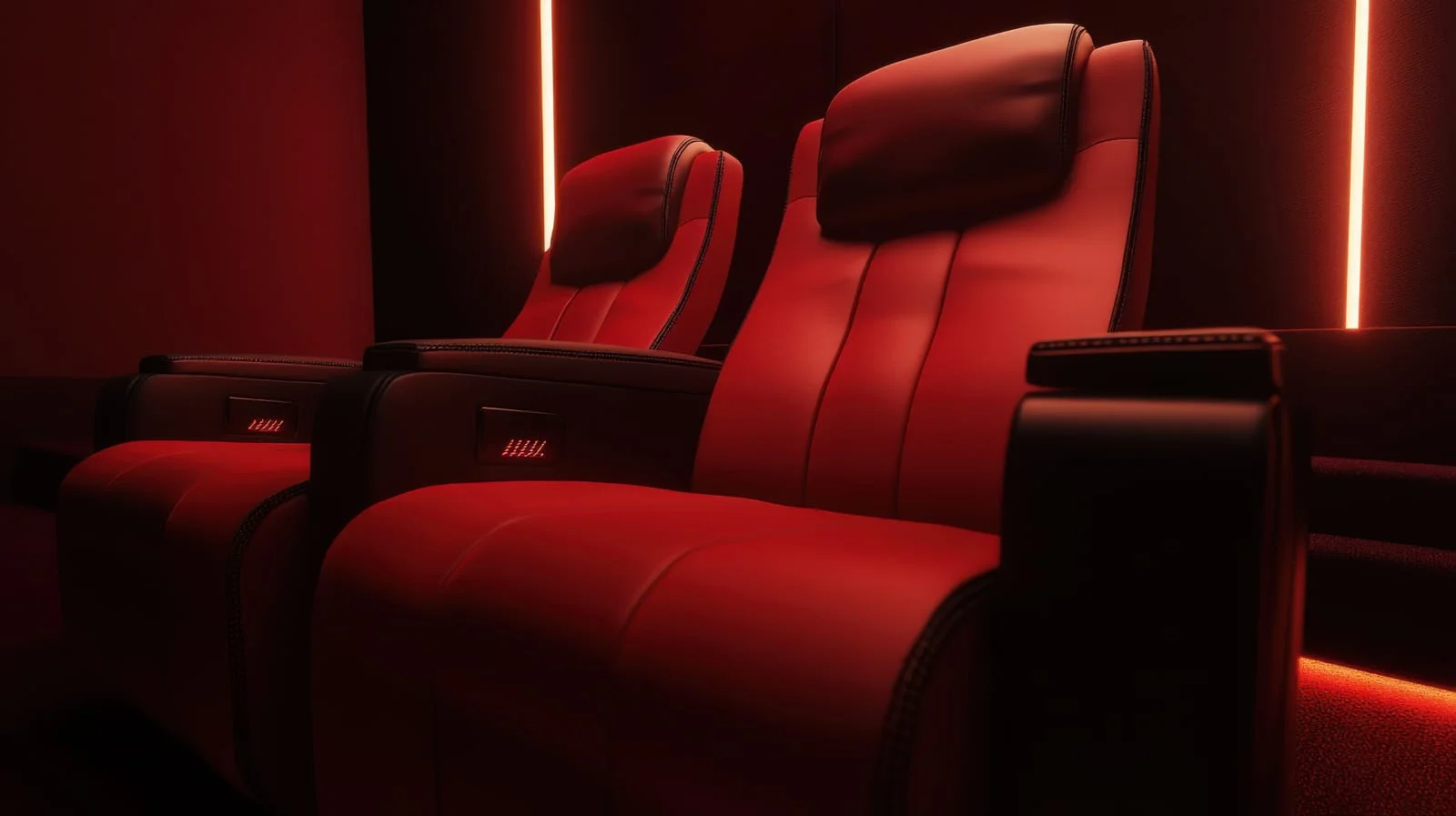
When to Choose Real Leather vs. Faux Leather
Choose real leather (top-grain or full-grain) when:
- The room is used daily or near-daily for extended viewing sessions
- The budget allows for a genuine long-term investment
- The room has climate control and consistent humidity
- Aesthetics and long-term value are a priority
Choose quality faux leather (commercial-grade PU) when:
- Budget is a firm constraint
- The room runs warm or lacks consistent climate control
- Young children or pets make easy cleaning the top priority
- The room serves multiple purposes beyond dedicated cinema viewing
Always avoid:
- Bonded leather at any price point — it fails predictably and within a few years
- Ungraded "genuine leather" with no further grade specification
- Budget PU leather in seats that will see daily, heavy use
For guidance on which brands offer which leather grades across different price tiers, the home theater seating brands page provides a useful comparison. Those also setting up a full room can consult the home theater design section for layout guidance alongside seating selection.
Frequently Asked Questions
What is the best leather for home theater seating? Top-grain leather offers the best balance of durability, softness, and value for most buyers. Full-grain is the highest quality tier but commands a significant price premium. Either outperforms bonded or faux leather in long-term use.
How do I tell the difference between real and faux leather on a seat? Real leather has natural grain variation, slight imperfections, and an organic smell. Faux leather has a perfectly uniform texture, a faint plastic smell when new, and a synthetic backing visible on cut edges. Always check the product specification rather than relying on visual inspection alone.
Is black leather theater seating harder to maintain? Black real leather requires the same conditioning schedule as other colors. Black faux leather tends to show surface cracking more visibly than lighter shades as it ages, and scuff marks read more clearly on dark finishes — making maintenance consistency more important.
Can faux leather be repaired if it starts peeling? Temporarily — patch kits and liquid leather products can cover small areas, but delamination is a structural failure. Once faux leather begins peeling, the degradation continues regardless of surface treatment. Real leather, by contrast, can be professionally refinished and reconditioned with lasting results.
The Right Choice Aligns with Your Lifestyle
The best leather home theater seating is the one that matches how the room is actually used — not just what looks best in a product listing. For buyers who watch frequently in a controlled environment and want seating that improves with age, real leather at a reputable quality grade is the clear choice. For buyers with variable conditions, younger households, or tighter budgets, quality commercial PU leather is a reasonable middle ground — provided bonded leather is ruled out entirely.
Comfort, durability, and maintenance requirements should lead the decision. A seat that looks perfect on delivery but requires replacement in four years is never the better value, regardless of the upfront price. For a curated selection of leather home theater seats across all quality tiers and configurations, visit Elite HTS.