
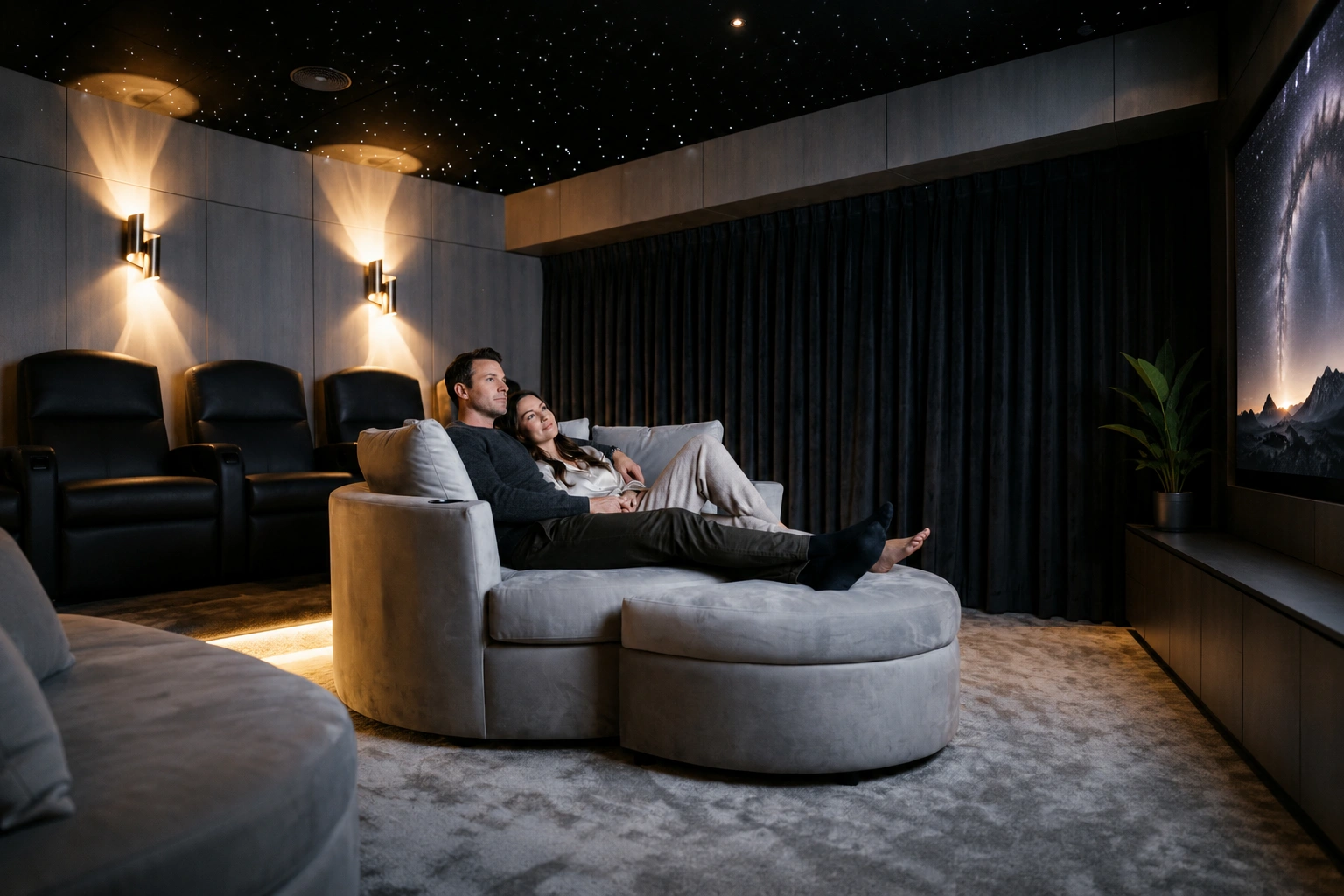

A great home cinema setup deserves equally great seating. Families invest heavily in screens, projectors, and audio systems – yet the couch often gets chosen last, or picked up simply because it fits the room aesthetically. The result is predictable: stiff necks, back pain, and a viewing space that nobody wants to use for long.
The global home theatre market was valued at $12.36 billion in 2024, driven largely by families building dedicated media rooms at home. Yet the seating is frequently the element that determines whether those rooms actually get used. A well-chosen home cinema couch isn't just comfortable – it supports proper posture, keeps drinks off the floor, handles real family conditions, and lasts long enough to justify the investment.
This guide covers every factor that matters: size, configuration, materials, built-in features, screen alignment, and budget. The goal is to help families make a decision they won't need to revisit in three years.
What Sets a Home Cinema Couch Apart from a Regular Sofa
Standard living room sofas are built for conversation – upright posture, face-to-face interaction, short sessions. A couch for home cinema use is engineered for the opposite: sustained forward-facing viewing, extended time seated, and the practical demands of family life.
That distinction goes deeper than just comfort preferences.
How Geometry Affects the Viewing Experience
The relationship between seat depth, back angle, headrest height, and screen position directly shapes how comfortable – or uncomfortable – a two-hour film will be.
Key ergonomic targets to look for:
- Back angle: 100–115 degrees supports the lumbar spine during long sessions without forcing a slouch
- Seat depth: 20–24 inches provides full thigh support, particularly important for children and shorter adults
- Headrest position: should align the viewer's eyes with the center of the screen at a natural resting position
- Seat height: typically 17–19 inches from the floor for standard screen placements
Screens mounted too high are one of the most common ergonomic mistakes in home cinema rooms. Sustained upward head tilt of even 15 degrees becomes painful after 45 minutes – a problem no amount of cushioning can fix for proper theater ergonomics.
.webp)
Built-In Features: Convenience That Adds Up Over Time
A quality home cinema couch integrates practical features that reduce the small interruptions that chip away at the viewing experience. These aren't optional extras – they're what separates purpose-built cinema seating from a regular sofa placed in front of a big screen.
Features worth prioritizing:
- Cup holders and pull-out trays – stable drink placement without needing side furniture
- USB-A and USB-C charging ports – removes the need for extension cables near seating
- Under-seat or in-arm storage – blankets, remotes, and controllers within reach
- Integrated LED base lighting – lets guests move safely in a darkened room
Wall-hugger recliners deserve a specific mention. Standard reclining seats need 12–18 inches of clearance behind the seat. Wall-hugger mechanisms reduce that requirement to 4–6 inches – a meaningful difference in compact or purpose-built rooms.
Durability That Holds Up to Family Use
Furniture showrooms are optimistic environments. Cushion foam that feels supportive at first can compress and lose its shape within months under daily family use. Upholstery that looks clean and polished can pill, fray, or crack after a season of regular use with pets and children.
Pro tip: Ask about foam density ratings before purchasing. High-resilience foam (2.0 lb density or higher) holds its shape significantly longer than standard furniture foam under regular use.
Build quality matters more with cinema seating than with most furniture. Commercial-grade frames and foams – the type used in actual cinema installations – represent the top tier of longevity for residential use as well.
How to Choose the Right Size and Configuration
Getting the size wrong is the most expensive mistake families make. A couch that's too small leaves people sitting on the floor. One that's too large eliminates recliner clearance and turns the room into an obstacle course.
A family of four generally works well with a 3–4 seat sectional or L-shaped configuration, which offers side-by-side viewing without rigid row seating. Two-row layouts are possible in larger rooms, but require a raised platform for the back row – full-size recliner headrests reach 48–54 inches high, which will block the screen for anyone seated directly behind at floor level.
Common sizing mistakes to avoid:
- Assuming one or two family members will consistently sit on the floor
- Selecting an oversized sectional that leaves no recliner extension clearance
- Forgetting to account for aisle space – a minimum of 30–36 inches between rows is the accepted standard for comfortable movement
- Designing for maximum guest capacity instead of typical family use
Modular configurations address the guest problem cleanly – additional sections can be added for larger gatherings without redesigning the room.
Selecting the Right Material for Real Family Life
Material choice tends to be where practical needs and visual preferences conflict the most. The table below breaks down the three main options honestly:
Stain-resistant microfiber offers the best balance for most families – it's soft enough for long sessions, handles spills with a quick wipe, and stands up reasonably well to pet claws. For households where pets are regular viewing companions, it consistently outperforms standard woven fabric on durability without the temperature drawbacks of leather.
Aligning the Couch with Screen Distance and Room Layout
Seating position affects both image quality and physical comfort in measurable ways. Sit too close to a large screen, and eye fatigue sets in quickly. Sit too far, and the resolution benefit of a high-quality display is largely lost.
Recommended viewing distances by resolution:
- 1080p content: 1.5–2.5× the screen's diagonal measurement
- 4K content: 1–1.5× the screen's diagonal measurement
- Example: A 100-inch 1080p screen places optimal seating between 12 and 20 feet from the screen surface
The center of the screen should align with seated eye level – approximately 42–48 inches from the floor for most adults. This is the single most overlooked detail in home cinema room planning.
Multi-purpose rooms add complexity. When the same space serves both casual lounging and dedicated viewing, modular seating that can be reconfigured for different uses is the most practical long-term solution.
Comfort, Durability, and Long-Term Value
The seating decision has more impact on how much a family actually uses a home cinema room than most other elements. A well-chosen home cinema couch removes the small irritants that accumulate over time – spills without anywhere to set a drink, posture discomfort halfway through a film, fighting over the one comfortable spot.
Families that treat the couch as a long-term investment rather than a budget line tend to get far more out of their home cinema spaces overall. The focus should be on ergonomic comfort, honest durability under real family conditions, and practical features that make the room function well every time.
Considering new seating for a home theater project? Elite HTS offers commercial-grade home cinema couches built in Canada, with custom upholstery available in any color, modular configurations for any room size, and a 20-year warranty. Contact the Elite HTS team for custom specifications and fabric samples.
Frequently Asked Questions
What is the ideal size of a home cinema couch for a family of four?
A 3–4 seat sectional or L-shaped configuration works well for most families of four. Modular options allow additional seating to be added without replacing the entire couch as the family grows. For spatial inspiration, check out our insights on choosing the right home theater seating for your space.
Are reclining sections necessary for family movie nights?
Not strictly required, but they make a noticeable difference for sessions over 90 minutes. Power recliners with wall-hugger mechanisms offer the best combination of comfort and space efficiency for tighter rooms. Learn what to look for in our guide to choosing the perfect home theater recliner for maximum comfort.
What is the best material for home cinema couches with kids and pets?
Stain-resistant microfiber or faux leather are the most practical choices. Faux leather wipes clean fastest; quality microfiber is more comfortable for extended sitting and better at holding warmth. To avoid standard material pitfalls, read about common mistakes when selecting home theater seating.
Can modular home cinema couches work for families?
Yes – and they're often the best option. Modular sections can be rearranged for different room uses and expanded without purchasing a completely new couch. See how they perform in our review of sectionals, cuddle couches, cinema recliners, and custom designs.
Do home cinema couches need special maintenance?
Quality options typically feature removable cushion covers or easy-clean upholstery. Leather and faux leather require occasional conditioning. Fabric upholstery may benefit from periodic professional cleaning depending on use intensity.
How far should the couch be from the screen?
For 1080p content, the recommended distance is 1.5–2.5× the screen diagonal. A 100-inch screen places optimal seating at 12–20 feet. 4K displays allow closer seating – roughly 1–1.5× the diagonal – without visible image degradation.